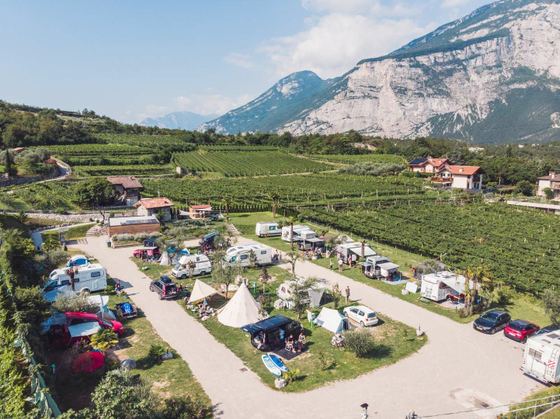
A wine route through the southern part of South Tyrol, crossing vineyards and little-known villages away from the main tourist flows. A niche itinerary to discover native grape varieties and high-altitude wine landscapes.
The South Tyrolean Strada del Vino — Südtiroler Weinstraße in the German name that lives alongside the Italian one on every road sign — runs from north to south along the eastern bank of the Adige, but it is in its southern stretch, around Magrè sulla Strada del Vino, that the landscape takes on a more intimate, less frequented character. Magrè, Margreid in German, is a municipality in the Bassa Atesina with just over a thousand inhabitants, set between the valley floor and the first slopes climbing toward the Trodena plateau. Here viticulture is not an attraction built for tourism: it is the very structure of the territory, the reason the villages exist in the form we find them today.
The vineyards surrounding Magrè and the hamlet of Favogna — Fennberg in German, set at a higher elevation on the eastern slope — produce varieties that reflect the area's dual climatic character. The Bassa Atesina enjoys some of the mildest temperatures in the entire province of Bolzano, with warm summers and winters tempered by the effect of Lake Caldaro just to the north. In this setting, Pinot Nero, Lagrein and Gewürztraminer ripen, grape varieties that find here a thermal range favorable to aromatic complexity. Favogna, at a higher elevation, adds a note of freshness that sets its grapes apart from those of the valley floor.
The route connecting these places is not a track artificially built for visitors, but largely follows roads and paths that Tyrolean farmers have trodden for centuries between vines and orchards. Apple and pear trees alternate with vines according to an agricultural logic that predates any tourism planning, and the villages preserve rural architecture — masi (Tyrolean farmsteads), underground cellars, stone portals — that belongs to Tyrolean farming culture without mediation. The dual naming of every place is not a folkloric detail: it is the visible trace of a history in which the border between the German-speaking and Italian-speaking worlds crossed these hills more than once over the course of the twentieth century, leaving a cultural layering still legible in the dialects, the menus, the wine labels.
To travel this section of the Strada del Vino means moving through a territory whose scale is that of detail: the single family choir loft, the dry-stone wall marking off a plot, the profile of a Romanesque bell tower rising among the rows of vines. The Bassa Atesina as a whole remains less mentioned than the areas around Bolzano or Merano, and Magrè in particular occupies a peripheral position even within this already understated picture. It is a condition that has preserved the place's ordinariness — in the precise sense of a territory that functions according to its own logic, regardless of outside attention.
Plentn · Public domain — Wikimedia Commons
Certified Made in Italy businesses close to this place.