Before you go on
This site uses only what it needs to work: the language you choose, access to the members' area, and anonymous counts that tell us whether the search is answering well. For advertising campaigns we ask your permission, and without a yes nothing starts. See the full list.

Ferrara preserves a tradition of artisan violin making that forms part of the wider heritage of ancient crafts in Romagna, tied to the building and restoration of stringed instruments.
Ferrara is a city that has managed, over the centuries, to preserve a close relationship between court life and the craft production that served it. Music was an integral part of life under the Este family — one need only think of Este patronage in the fifteenth and sixteenth centuries — and the making of stringed instruments was no marginal activity, but a trade that answered a real and cultivated demand. In this context a tradition of violin making took root and grew, one that, while never achieving the international visibility of Cremona, produced craftsmen of real standing and left documented traces in the history of Italian music.
Among the names this tradition produced in the twentieth century, the Pareschi family holds a distinct place. Gaetano Pareschi (1900–1987) built his first instrument at the age of fourteen — a guitar and a mandolin — and after a period working also as a violinist, chose to devote himself entirely to violin making. To do so, he trained in Ferrara at the workshop of Ettore Soffritti, a Ferrarese violin maker who was already a local point of reference for passing on working techniques. His nephew Gabriele Pareschi (1924–1996) continued along the same path. The family's story has been reconstructed by Matteo Marsili, a young violin maker from Casalmaggiore, in the book *Pareschi. Una famiglia di liutai ferraresi nella liuteria del '900* (Pareschi: a family of Ferrarese violin makers in twentieth-century instrument making), published by Delmiglio and presented at the Ridotto del Teatro di Ferrara, with the collaboration of Antonella Pareschi, granddaughter of the two craftsmen.
What emerges from this story is the mechanism by which technical knowledge is passed down: not through formal schools, but through physical proximity, direct observation, years spent in the workshop beside someone who already knows. Soffritti's workshop functioned as a node in an informal network of learning, and the Pareschi family were a documented outcome of it. This model of transmission — fragile by definition, dependent on the biographical continuity of a few people — is the same one that shaped Italian violin making in many smaller centres, where the survival of the craft depended on the will of individuals to carry it forward.
Today, violin making in Ferrara does not form a production district in the industrial sense of the term, nor a school formally recognised as Cremona's is. It remains rather a discreet presence, rooted in the city's craft memory and in a handful of workshops that continue to work wood according to traditional methods. The fact that a book was needed to bring the Pareschi family's story back to light says something about the condition of this knowledge: it exists, it existed with intensity, but it risks dissolving in the absence of documentation. Ferrara, a city that has known how to make the most of its Renaissance heritage right up to UNESCO recognition in 1995, also carries this less visible layer — that of the hands that work the wood, bend it, tune it to sound.
Ввласенко · CC BY-SA 3.0 — Wikimedia Commons
Certified Made in Italy businesses close to this place.
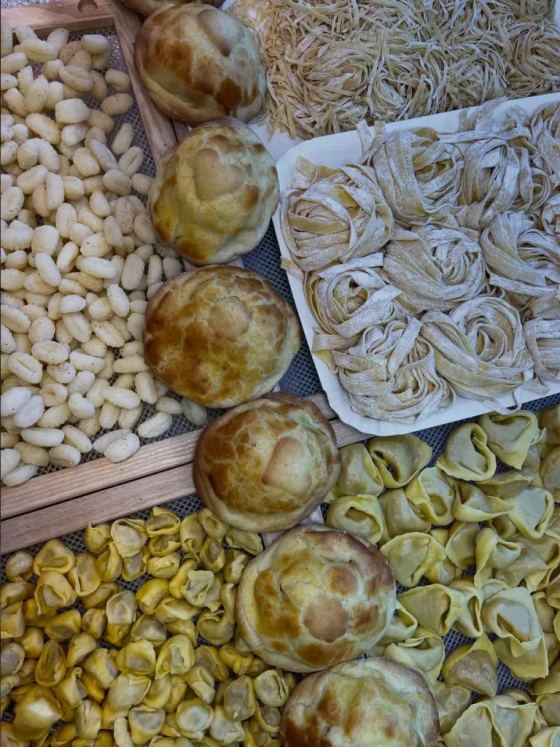
Pasta Fresca La Spoja
Ferrara (FE) · 1 km
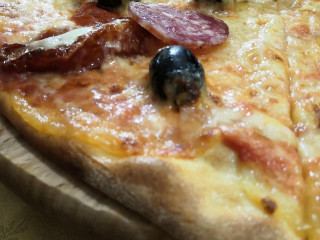
PIZZERIA AL PONTE
Polesella (RO) · 17.5 km
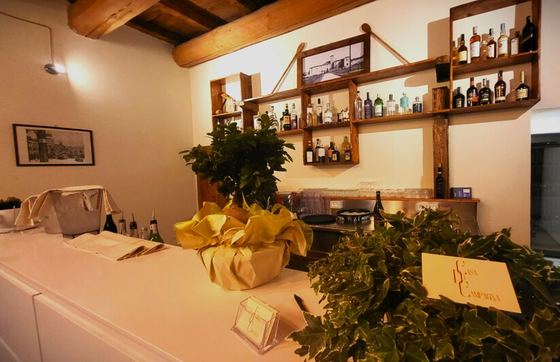
RISTORANTE CASA DI CAMPAGNA
Cento (FE) · 23.8 km
GOLDEN HAIR DI FRANCESCA
Molinella (BO) · 24.4 km
P&P SERVICE SRL - SEMPLIFICATA
Finale Emilia (MO) · 24.9 km
SOCIETA' AGRICOLA FARINA 2.0
Ferrara (FE) · 28.7 km