
Towering sandstone spires rising from the Apennine hills near Guiglia, a peregrine falcon nesting site and a geological landscape of rare beauty.
In the heart of the Apennines above Modena, between Guiglia, Marano sul Panaro and Zocca, the rolling landscape gives way to a sudden fracture. From the soft profile of the hills rise two sandstone towers — the Sassi di Roccamalatina and Sant'Andrea (the "Rocks" of Roccamalatina and Sant'Andrea) — climbing over seventy metres with walls that are nearly vertical. This is no gradual formation, no ridge that grows with the land: the rock rises bare, without transition, as though the ground had given way around it, leaving standing only what resisted. The contrast with the gentle curves of the surrounding countryside is the first thing one notices, and it lingers.
The Parco Regionale dei Sassi di Roccamalatina (Roccamalatina Rocks Regional Park), established to protect this territory, covers over two thousand hectares and takes in a significant portion of the municipality of Guiglia — around a quarter of its total area. The geology behind these monoliths is typical of the northern Apennines: layers of sandstone laid down in a marine environment and later uplifted, eroded over time until only the most compact structures remained. The towers are what is left after millennia of shaping, witnesses to a stratigraphy still legible on the exposed walls.
The sheer verticality of the rocks has always drawn those in search of defensible ground. Some historical accounts suggest the Sassi hosted fortified settlements as early as the Byzantine era, and in the centuries that followed they continued to mark the territory as visual and strategic landmarks. Around them a human landscape took shape whose traces are still legible today: the Pieve di Trebbio, a church probably founded between the 11th and 12th centuries, and the medieval villages of Castellino delle Formiche and Castellaro, examples of rural architecture scattered across the slopes of the park.
Today those same walls are home to species that depend on stable, undisturbed rock faces. The peregrine falcon nests on the Sassi with documented continuity, and the wallcreeper — a rare bird in the Emilian Apennines — spends its winter months there. The kestrel, too, frequents the crevices of the rock. The site's bird life is thus directly tied to its morphology: without those seventy metres of wall, there would be no ecological niche, and without the niche, no birds of prey. The shape of the place determines who lives in it.
The Panaro river flows nearby, running toward Modena, and helps define the hydrographic system within which the park sits. The provincial capital lies about thirty-four kilometres away — far enough to keep the site off the busiest routes, while remaining within easy reach. It is this middle position, neither remote nor absorbed into mass tourism, that preserves a certain quality of silence found while walking among the hills and looking up toward the spires.
Patafisik · CC BY-SA 4.0 — Wikimedia Commons
Certified Made in Italy businesses close to this place.
Ricevimenti La Vecchia Quercia
Serramazzoni (MO) · 9.6 km

LA CARNERIA MAROTTA NICOLA
Valsamoggia (BO) · 13.2 km

PIZZERIA ANTONIO SORBINO
Castelnuovo Rangone (MO) · 13.6 km
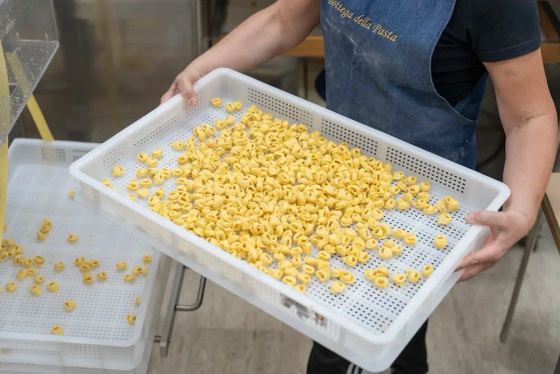
BOTTEGA DELLA PASTA DAL 1986
Formigine (MO) · 18.3 km
PIZZERIA VESUVIANI - Il Vero Segreto Della Pizza
Modena (MO) · 20.5 km
Ristorante La Vecchia Filanda
Modena (MO) · 20.6 km
