Before you go on
This site uses only what it needs to work: the language you choose, access to the members' area, and anonymous counts that tell us whether the search is answering well. For advertising campaigns we ask your permission, and without a yes nothing starts. See the full list.

A religious building constructed by the monks of Farfa on the ruins of a small pagan temple dedicated to Artemis, set apart from the villages of the Marche. A place where pagan and Christian history layer within a little-frequented natural setting.
At the foot of Monte Ascensione, in a small clearing that the woods surround without closing in, stands the Santuario della Madonna della Consolazione, also known as the santuario di Montemisio (Montemisio sanctuary). Its position — set apart from the villages of the valley, reached along a path that breaks off from the ordinary road network — is no accident: it answers to a logic of sacredness of place that predates the current structure by centuries and reaches back to a time when the goddess Artemis was venerated here.
The church was built by the monks of the Abbazia di Farfa (Abbey of Farfa), one of the most influential Benedictine monasteries of medieval central Italy, over the ruins of a small pagan temple dedicated to Artemis, or Artemisia according to some local variants of the name. This layering is not an antiquarian detail: it is the very logic by which medieval Christianity took root in the Apennine territory, choosing sites already charged with use and meaning, and transforming their sign without erasing their memory. This place bears both imprints, though the second can now be read only through oral tradition and the site's own position.
The Marian cult that developed here took on different names over time, each tied to a precise function in the life of the surrounding rural communities. It was first venerated as Madonna della Cintura, then as Madonna della Tempera — where "tempera" evokes water, the moisture the fields required, that agrarian dimension in which the sacred and the cycle of the seasons were inseparable. A local legend tells that during a period of drought threatening the harvest, the community gathered in prayer at this sanctuary: the tale, in its structure, is common to many Apennine places of worship, but here it is interwoven with the layering of names and devotions in a way that captures the complexity of a territory that has always had to negotiate with scarcity and the uncertainty of climate.
The landscape in which the sanctuary sits belongs to that hilly, pre-Apennine band of the southern Marche that has never sought visibility. Monte Ascensione, at 1,105 meters, dominates an area that preserves a density of small settlements, parish churches and minor places of worship documenting a religious colonization of the land that was thorough and persistent. The santuario di Montemisio occupies a peripheral but not marginal place in this network: its Farfa monastic origin connects it to circuits of power and culture that in the Middle Ages ran across the entire peninsula.
Sirleonidas · CC BY-SA 4.0 — Wikimedia Commons
Certified Made in Italy businesses close to this place.
Bar Centrale Gelateria Incicco
San Ginesio (MC) · 8.4 km

Fior di Pizza Pizzeria al Taglio
Colmurano (MC) · 10.5 km

SOCIETA' AGRICOLA FERIOLI
Fiastra Località Polverina (MC) · about 13 km
Antica Fornace
Treia (MC) · 17.3 km
Palazzo Riccucci Resort
Montappone (FM) · 18.4 km
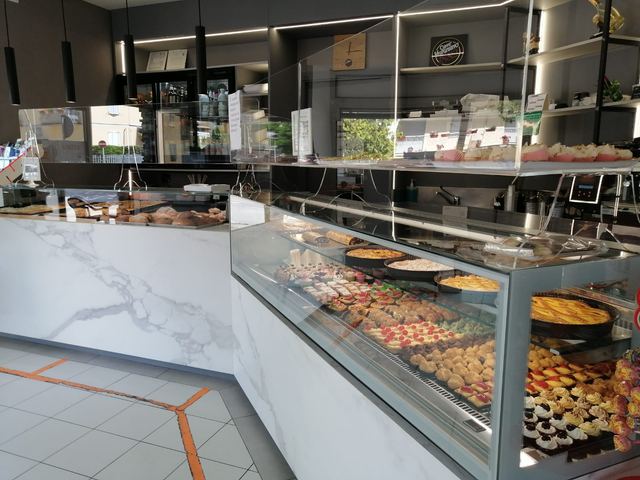
La Gustosa
Matelica (MC) · 21.6 km