
A hilltop hamlet in the municipality of Sanremo, built on the ruins of a village abandoned after the 1887 earthquake, now a lively artists' colony home to international craftspeople and artists.
At six in the morning on 23 February 1887, an earthquake of estimated magnitude around 6.7 struck western Liguria with great violence. The epicentre lay offshore, off Diano Marina, but the seismic wave reached the inland area around Sanremo with full force, and Bussana — a medieval village perched on a hilltop spur roughly 200 metres above sea level — was among the places hit hardest. The vaults of the church of Sant'Egidio collapsed during early morning mass, burying the congregation beneath the rubble. The death toll in the village was high. The survivors moved down into the valley and never returned: the municipality built a new settlement further below, Bussana Nuova, and the old village was left abandoned, given over to vegetation and the slow crumbling of stone.
For nearly seventy years Bussana Vecchia remained in that state of suspension which period photographs capture with precision: walls open to the sky, arches propped up under the weight of the years, the bell tower of Sant'Egidio still standing as a vertical marker in a horizontal landscape of ruin. It was in the 1960s that the village began to be reoccupied, not by institutional decision but through the spontaneous initiative of artists and craftspeople arriving from various parts of Europe. The painter Clizia, the artistic name of Mario Giani, is considered among the first to settle permanently amid those ruins, around 1961. Others followed, drawn by the idea of a collective workshop removed from the logic of the market and conventional urban planning.
The reoccupation took place in a legal grey area that has never been fully resolved. The historic residents of Bussana Nuova long claimed ownership of the abandoned buildings, while the municipality of Sanremo considered the structures derelict and unfit for habitation. The artists who settled there worked for decades in this uncertain zone, restoring walls and roofs at their own expense without ever being able to obtain proper building permits. This tension has run through the whole recent history of the village and shaped its character: a community that built its identity partly through resistance to ordinary procedure.
Today Bussana Vecchia is home to workshops for ceramics, sculpture, painting and goldsmithing, galleries carved out of what were once domestic rooms, and exhibition spaces opening directly onto the stone alleys. The church of Sant'Egidio, its nave open to the sky and its walls covered in wild vegetation, remains the visual and symbolic centre of the village: it has not been restored in the conventional sense, and this choice — or this impossibility — gives it an architectural presence that no restoration work could ever have produced. The narrow lanes climb toward the top of the spur, with supporting arches spanning the roadway and workshops opening directly onto the pedestrian path.
The tension between ruin and dwelling is the enduring character of Bussana Vecchia. It is neither a restored village nor an open-air museum: it is a place where historical discontinuity has remained visible, where the 1887 earthquake and the reoccupation of the 1960s coexist within the same walls. This layering — medieval, seismically interrupted, then reinvented by an international community of craftspeople — makes Bussana Vecchia a difficult case to place within the geography of Italian villages, and perhaps it is precisely this difficulty that keeps it so persistently present in the memory of anyone who has passed through it, even just once.
Michael Schmalenstroer · CC BY-SA 4.0 — Wikimedia Commons
Certified Made in Italy businesses close to this place.
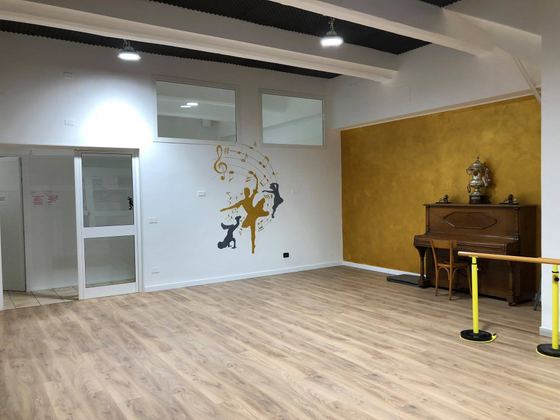
Scuola Danza Città Dei Fiori Asd
San Remo (IM) · 1.9 km
BAR SAN SCI'
Sanremo (IM) · 2.1 km
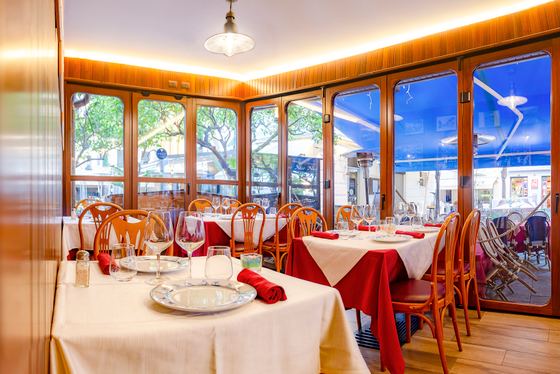
Ristorante Da Nicò - Sanremo
Sanremo (IM) · 2.2 km
Studio D'Arredo Graziella Vero
San Remo (IM) · 2.3 km
BASILICO E PINOLI
Sanremo (IM) · 3.2 km
LA TAVERNA BAKERY
Bussana (IM) · 5 km
