An Alpine plateau in Trentino dotted with lakes, woods and medieval castles, known for its apple orchards yet still little frequented compared with the more celebrated Alpine valleys. Its towns preserve a natural and cultural landscape that has remained substantially intact.
The Val di Non occupies a plateau that opens amid the mountains of western Trentino, with a geometry unusual for the surrounding Alpine landscape: not a narrow, vertical valley, but an expansive territory, shaped by gentle hills, dense woods and stretches of water that punctuate the terrain with a certain regularity. Cles, the main town, looks out over Lago di Santa Giustina, an artificial basin created in the 1950s by damming the Noce river, whose waters submerged part of the ancient valley floor, giving the landscape a lakeside presence that today feels entirely natural.
The territory retains a historical layering still legible in the shape of the places themselves. Medieval castles emerge from the wooded slopes — Castel Cles, Castel Bragher, Castel Valer (castles) — built in different eras to control the trade routes that crossed the valley toward Passo della Mendola and the Germanic world. The sanctuaries scattered along the hillsides bear witness to a deep-rooted popular devotion, which has left its architectural mark even in the smaller villages. In the background, the Dolomiti di Brenta and the Maddalene range define the horizon without ever overwhelming it, preserving that sense of openness which distinguishes plateaus from deep-set valleys.
Lago di Tovel, in the western part of the valley, is perhaps the best-known landscape feature outside Trentino. Sitting at about 1,178 metres, it is ringed by fir and beech woods that follow its shores in an almost unbroken line. For decades it was also known for the summer reddening of its waters, caused by the bloom of a red alga, Glenodinium sanguineum, which since the second half of the twentieth century has stopped occurring for reasons still debated among researchers. The lake remains today one of the few Alpine basins of glacial origin where human pressure has stayed limited.
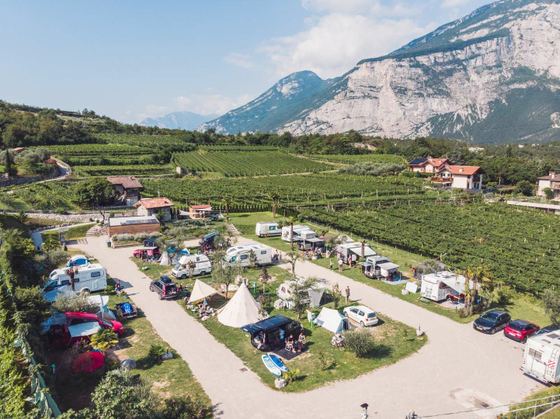
The apple orchards of the Val di Non cover much of the cultivated land and have shaped the agricultural landscape in a distinctive way: neat rows of low trees stretch across the sun-facing slopes, interspersed with hedges and dry-stone walls marking the boundaries between plots. The Val di Non apple holds a protected designation of origin and represents one of the most substantial fruit-growing productions in the Italian Alps. This agricultural vocation has helped keep the territory open and inhabited, slowing the processes of abandonment that affected other mountain areas of Trentino over the course of the twentieth century.
Its relative distance from the more heavily frequented tourist circuits — the eastern Dolomites, Lago di Garda, Val Gardena — has preserved a pace of its own for the Val di Non. The towns retain civic and commercial functions rooted in local life, and the landscape has not undergone the infrastructural transformations that elsewhere have reshaped Alpine valley floors. It is a condition that depends on precise economic and geographic factors, not on a deliberate choice, but the result is a territory where the continuity between past and present remains visible in the very shape of the land.
GianoM · CC BY-SA 4.0 — Wikimedia Commons
Certified Made in Italy businesses close to this place.