Before you go on
This site uses only what it needs to work: the language you choose, access to the members' area, and anonymous counts that tell us whether the search is answering well. For advertising campaigns we ask your permission, and without a yes nothing starts. See the full list.

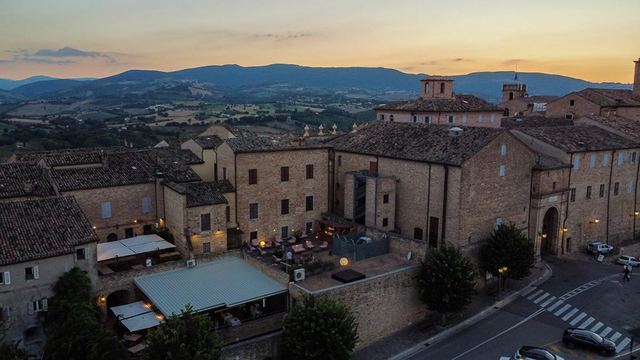
A village in the province of Macerata with a deep-rooted vocation for ceramics, whose origins date back to the Middle Ages thanks to the quality of the local clay. The rhythmic sound of wheels at work still rises from its artisan workshops today.
Appignano is a village in the province of Macerata whose deepest identity owes nothing to a monument or a particular landscape, but to a gesture: hands pressing clay on the wheel. The village's ceramic vocation is rooted in the Middle Ages, when the quality of the clay extracted from the hilly territory of the central Marche made it both practical and natural to develop a local production. Since then, the working of "cocci" (pottery shards, as the local ceramic pieces are called) — known in dialect as *coccià*, a term that also designates its makers — has never left the village, layering itself over the centuries until it became part of the very soundscape and visual fabric of the historic centre.
The bond between Appignano and ceramics is not only a matter of craft: it is also linguistic and identity-bound. The village's very name, according to some interpretations, recalls the term *pignatta*, the terracotta vessel that stands as the quintessential cooking pot of Marche peasant cuisine. The workshops still active in the village today preserve techniques passed down directly from one generation to the next, in which the pedal or electric wheel remains the central tool, and firing follows times and temperatures that each master knows through years of accumulated experience. This is no folkloric re-enactment: production ranges from everyday objects to decorative pieces, with a continuity of method that sets this craft apart from industrial ceramics.
Gathering and ordering this material memory is the task of the MArC – Museo dell'Arte Ceramica di Appignano (Museum of Ceramic Art of Appignano), housed in the village and dedicated to the history of local production. The museum's collection spans a period stretching from Roman-era artefacts to the contemporary tradition of the *coccià*, documenting how the earth of this territory has been shaped, fired and returned in different forms across the centuries. The museum does not limit itself to conservation: it also serves as a point of reference for understanding the technical and cultural context in which the still-active workshops operate.
Walking through Appignano in the morning hours, as the workshops open and the wheels begin to turn, reveals a dimension of craft work rarely found so deeply woven into the urban fabric of an inhabited centre. The rhythmic sound of the work filters through doorways, and the smell of wet clay lingers in the alleys. Appignano is one of those places where an ancient trade has endured not out of inertia, but because it has continued to find those who practise it and those who recognise it as their own.
Diego Baglieri · CC BY-SA 4.0 — Wikimedia Commons
Certified Made in Italy businesses close to this place.
Antica Fornace
Treia (MC) · 6.5 km
ONORANZE FUNEBRI BRACALENTI - di BRACALENTI ENRICO E ANDREA
Montecassiano (MC) · 9.4 km

SOC AGR.TRE CASTELLI - LE VIGNE DI LEO
Staffolo (AN) · 15 km
Vetreria Gorbini - Artigiani Professionisti del Vetro dal 1950
Corridonia (MC) · 15.8 km
THE BIGO'S LAB
MONTELUPONE (MC) · 18 km
Donna Lù Biga & Dolcezze
Morrovalle (MC) · 19.9 km