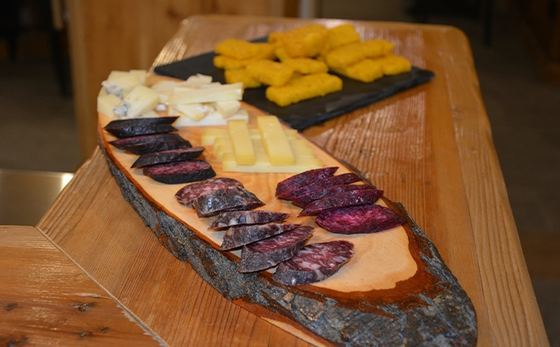
Teteun — salted, slow-cooked cow's udder — and the jambon à la braise of Saint-Oyen are dishes of Valdostano peasant tradition tied to practices of thrift and neighbourliness, documented in the handwritten recipes of Gignod and Saint-Oyen.
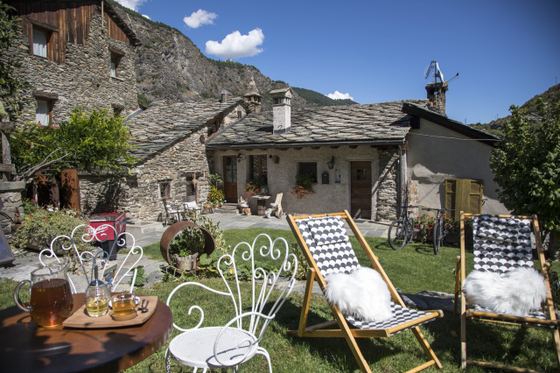
Saint-Oyen is a small municipality in Valle d'Aosta, set along the road leading to the Gran San Bernardo pass, a few kilometres from Aosta towards the Swiss border. The landscape is typical of the side alpine valleys: high-altitude pastures, conifer woods, compact villages where houses huddle together as if to defend themselves from winter. It was in this context of a closed economy and measured resources that two dishes of Valdostano peasant tradition took shape — teteun and jambon à la braise — bound not only to culinary technique but to a precise culture of the animal body, of time, and of community.
Teteun is cow's udder, salted and then slow-cooked for four or five hours, until the surface takes on a compact golden colour. Trimmed of fat and sliced, it is served with seasonal side dishes. The preparation belongs to the logic of using the whole animal, a practice that in alpine communities was not an aesthetic choice but a structural necessity: every part of a slaughtered animal had a precise destination, and nothing was wasted. The recipe was recorded by Lelio Milliery of Gignod, and this handwritten transcription is one of the few documented testimonies of a cuisine that for centuries was passed down orally, from hand to hand, among the families of the villages.
The jambon à la braise of Saint-Oyen belongs to a different register, though it shares the same economic and social roots. It is a ham cooked over embers, a preparation tied to the custom of the collective pig slaughter — a moment that in alpine communities marked the winter calendar and involved several families of the village. Cooking over embers turned an act of subsistence into a shared occasion: the fire, the waiting time, the division of the finished product were all part of a neighbourly ritual that strengthened bonds between families. Today the jambon à la braise of Saint-Oyen is recognised among Valle d'Aosta's traditional agri-food products, and the Pro Loco (local tourist board) of Saint-Oyen keeps its memory alive, taking part in the valley's food and wine events.
What unites these two preparations is the distance separating them from any cuisine of display. They were not made to be shown off, but to nourish and to avoid waste. Yet it is precisely this origin that makes them readable as documents: they tell the economic structure of an alpine society in which cattle and pig farming set the rhythm of the year, in which salting and long cooking were tools of preservation before they were tools of flavour, and in which the boundary between domestic cooking and collective practice was constantly permeable. The handwritten recipes of Gignod and Saint-Oyen are, in this sense, historical sources no less than chronicles or land registries: they fix a way of being in the world that food modernisation has made distant, but not erased.
Patafisik · CC BY-SA 3.0 — Wikimedia Commons
Certified Made in Italy businesses close to this place.