Before you go on
This site uses only what it needs to work: the language you choose, access to the members' area, and anonymous counts that tell us whether the search is answering well. For advertising campaigns we ask your permission, and without a yes nothing starts. See the full list.
A fine example of a 17th-century heated room from Monclassico in Val di Sole, now preserved at the Tiroler Volkskunstmuseum in Innsbruck as a testament to local woodcraft.
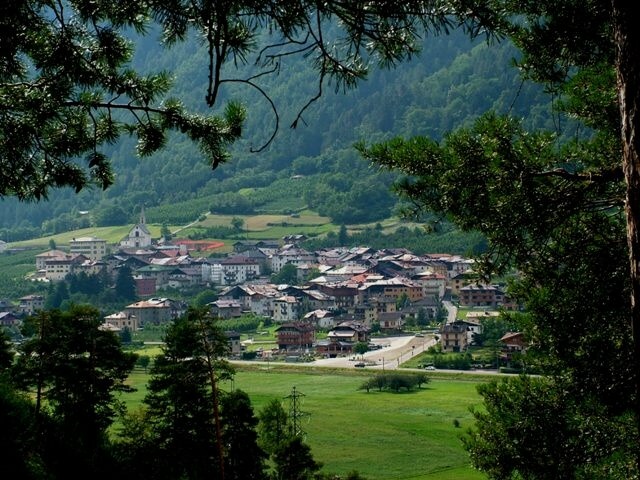
Monclassico is a hamlet within the municipality of Dimaro Folgarida, in Val di Sole, at 782 metres above sea level. The village belongs to that band of Trentino alpine settlements which, over centuries, developed a precise material culture built around the resources of the forest, the long cold, and the need to inhabit warm, gathered spaces through the winter months. It is from this context that the *stua* emerges — the heated room entirely lined in carved wood that stands as one of the most refined outcomes of woodcraft in the eastern Alps.
The *stua* of Monclassico, datable to the 17th century, was the thermal and symbolic heart of the house: an enclosed space, lined with carefully worked wooden panels, where surfaces were never left raw but treated with carving, moulding, and at times inscriptions or geometric motifs. Its function was practical — to concentrate heat and insulate against the cold of the stone walls — but the execution revealed an ambition that went beyond mere utility. The choice of wood, the quality of the cut, the decorative coherence of the whole: everything pointed to craftsmen who knew their material with a familiarity passed down through generations, within a tradition shared with Tyrol and the neighbouring valleys.
This *stua* is no longer in Monclassico. It was transferred to the Tiroler Volkskunstmuseum (Tyrolean Folk Art Museum) in Innsbruck, where it is still preserved today as one of the most significant examples of this type of interior from Trentino. Its absence from its place of origin belongs to a broader history of acquisitions and displacements of alpine heritage that took place between the 19th and 20th centuries, when ethnographic museums in German-speaking areas systematically gathered artefacts from the surrounding alpine regions. What remains in Monclassico and in Val di Sole is the memory of this tradition, traceable in a number of historic houses in the valley and documented through the work of the Centro Studi per la Val di Sole (Val di Sole Study Centre) and the Museo della Civiltà Solandra (Museum of Solandra Culture).
The case of the Monclassico *stua* raises a concrete question about the relationship between artisan heritage and territory: an object built to inhabit a specific space, conceived in relation to a climate, a community, a chain of local knowledge, is fully understood only when the context it comes from is known. Innsbruck preserves the form. Val di Sole still holds, in its historic architecture and in the continuity of certain practices, the logic that gave rise to that form.
Christian Stringari · CC BY-SA 3.0 — Wikimedia Commons
Certified Made in Italy businesses close to this place.