Before you go on
This site uses only what it needs to work: the language you choose, access to the members' area, and anonymous counts that tell us whether the search is answering well. For advertising campaigns we ask your permission, and without a yes nothing starts. See the full list.

An area of roughly 1,662 hectares on the border between Marche and Tuscany, across the municipalities of Sestino, Piandimeleto, Frontino, Carpegna and Pennabilli, with pastures and woodland used uninterruptedly for centuries.
Among the folds of the central-northern Apennines, where the ridge divides the waters flowing toward the Adriatic from those seeking the Tiber, there is a stretch of territory that belongs to two regions at once without belonging fully to either. The historic rural landscape of the Alta Valmarecchia in the Marche covers roughly 1,662 hectares along the border between Marche and Tuscany, across the municipalities of Sestino, Piandimeleto, Frontino, Carpegna and Pennabilli. It is an area that administrative cartography struggles to contain within a single frame, and this geographical ambiguity has, over the centuries, helped keep it on the margins of the great currents of change.
Its listing in the Registro Nazionale dei Paesaggi Rurali Storici (National Register of Historic Rural Landscapes) — the instrument established by the Ministry of Agricultural, Food and Forestry Policies to protect agrarian landscapes of proven historical continuity — certifies what direct observation confirms: pastures and woodland alternate here according to a logic that has not substantially changed in centuries. The agropastoral practices that shaped this territory are not folkloric remnants but working systems, still legible in the layout of the clearings, the routes of the drovers' tracks, the shape of the plots. Scientific coordination of the analysis behind the nomination was entrusted to Professor Mauro Agnoletti of the University of Florence, a leading scholar of the history of the Italian rural landscape.
The morphology of the place is typical of the Umbria-Marche Apennines in their northern stretch: mid-elevation ridges, slopes cut by streams feeding into the Marecchia, woodland cover opening into clearings where grazing has retained its productive function over time. This is not a spectacular landscape in the Alpine sense, but a space built by the patience of generations, where every element — the coppiced wood, the permanent meadow, the ridge path — occupies a position that answers a precise need. This internal coherence is what sets it apart from rural landscapes that have suffered the pressures of intensive agriculture or accelerated abandonment.
The area's low footfall is no accident. The municipalities involved belong to that band of inland Apennines which in recent decades has seen progressive depopulation, with some of the lowest population densities in the northern Marche. Sestino, the Tuscan municipality that often lends its name to the whole border area, counts just over 1,300 residents across a territory of some 80 square kilometres. This demographic thinning has had the side effect of preserving an environmental balance lost elsewhere: less settlement pressure, less infrastructure, less alteration of the soil. The landscape has remained legible because the territory has, to a large extent, remained on the margins.
What the National Register recognises in this corner of the Apennines, then, is the persistence of a system, not the presence of a monument. The distinction matters: this is not about protecting a single valuable feature, but about preserving the relationship between elements — between woodland and pasture, between slope and valley, between human use and the natural cycle. At a time when the Italian rural landscape is drawing growing attention, including at the level of European policy, the Alta Valmarecchia in the Marche stands as a case where geographical marginality has, paradoxically, proven to be a form of protection.
Alessandro.puleri · Public domain — Wikimedia Commons
Certified Made in Italy businesses close to this place.
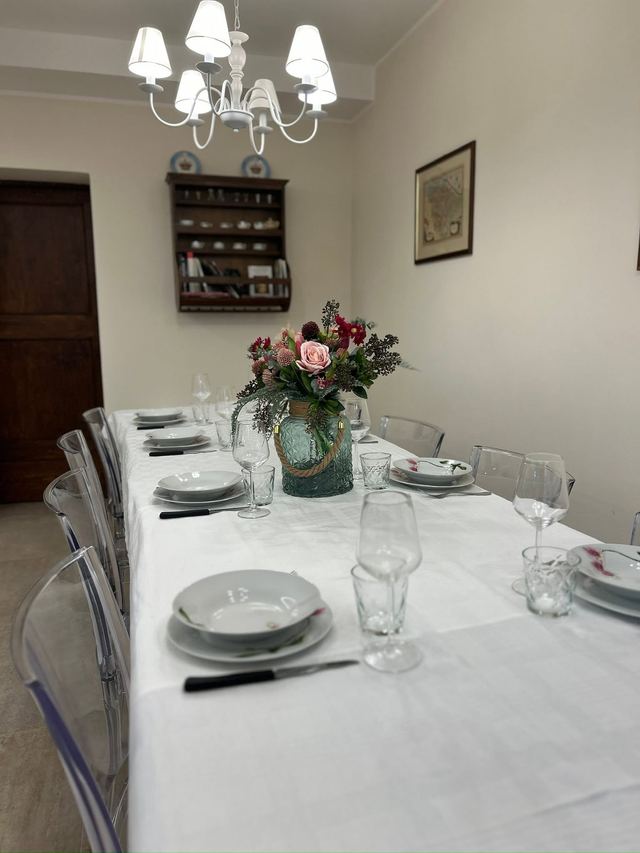
CA' SIMONCELLI - IL CASALE NEL BOSCO
Apecchio (PU) · 24.3 km
Crocché & CO
Città di Castello (PG) · 27.3 km

Zingarella
Città di San Marino (SM) · 28.1 km

SKYECAFE
Città di Castello (PG) · 28.9 km
Il Triangolo Pizzeria
Pietralunga (PG) · 31.7 km
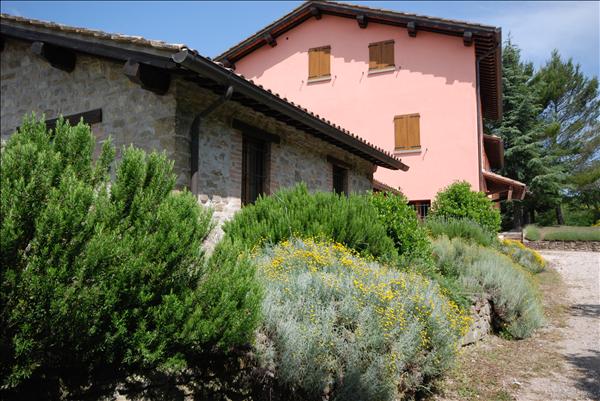
Agriturismo Monterosello
Città di Castello (PG) · 32.8 km