Isolated hamlet in the municipality of Riomaggiore, reachable only on foot via a steep path, overlooking crystalline waters amid terraced vineyards and sheer rock.
Monesteroli does not appear on the maps of organised tours, has no landing point for scheduled boats, and cannot be reached by car. Administratively it belongs to the municipality of Riomaggiore, in the province of La Spezia, and falls within the Cinque Terre National Park, but its geographical position — wedged between Riomaggiore and Portovenere, along a stretch of coast that curves toward the gulf — keeps it outside the circuits that bring millions of visitors to the five famous villages every year. Anyone wishing to reach it must choose between just two routes: the open sea or the footpath.
The footpath is what locals call the Scala del Paradiso (Stairway to Paradise), a route of roughly 1,100 steps cut into rock and earth that descends from the top of the headland down to the shore. The descent runs through the terraced vineyards that mark this entire stretch of coastline: dry-stone walls built up over centuries to wrest cultivable ground from the slope, rows that produce grapes destined for the wines of the Cinque Terre DOC designation. The drop is steep, the path exposed, and for a long period it remained closed for safety reasons, reopening to the public only in recent years after work to secure it.
At the foot of the steps a small cove of dark pebbles opens up, hemmed in by rock walls that fall straight into the Mediterranean. Here stand the hamlet's few dwellings — a handful of stone houses, some still lived in, though the resident population has dwindled to a very small number. There are no services, no electricity from the ordinary grid, none of the background noise that comes with any settlement connected to the normal road network. The soundscape here is that of the rocky coast: wind, waves, the occasional gull.
This condition of isolation is not the result of recent abandonment, but of a terrain that never allowed the kind of infrastructural development seen elsewhere. While the Cinque Terre were reached by the railway in the second half of the nineteenth century — a transformation that profoundly reshaped the economy and demography of the whole coast — Monesteroli remained outside any line of connection. Its inhabitants lived by fishing and winegrowing, carrying on their backs up and down the steps everything that could not arrive by sea. That way of life has vanished, but the shape of the place has remained intact.
The reopening of the footpath has made Monesteroli accessible to more hikers than in the past, but the difficulty of the route — and above all the need to climb back up those same 1,100 steps to leave — continues to select who actually arrives. The hamlet remains one of the few points on the Riviera di Levante where the relationship between coast and hinterland can still be read in its original form, without mediation.
Certified Made in Italy businesses close to this place.
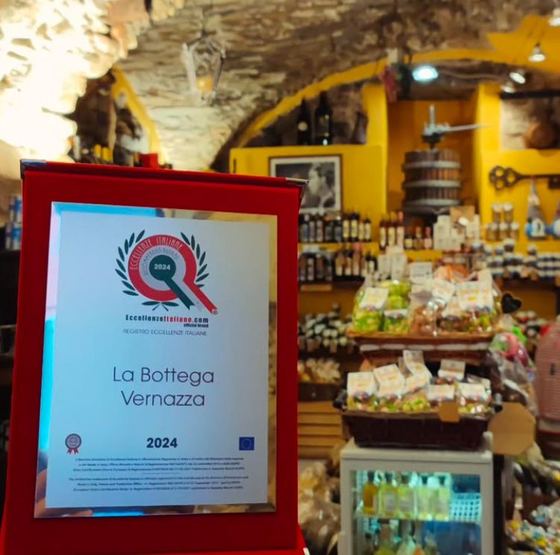
La Bottega Vernazza
Vernazza (SP) · 5.9 km
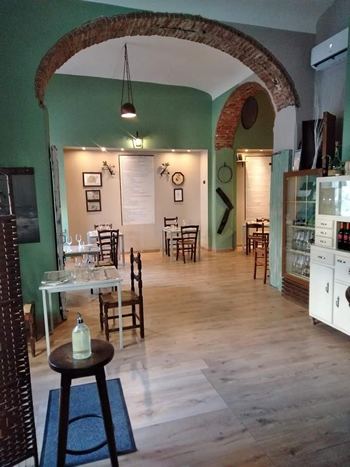
Antica Osteria dei Camalli
La Spezia (SP) · 6.8 km
GUSTO SICILIANO
La Spezia (SP) · 7.8 km
LA CASA DELLA POMPA
La Spezia (SP) · 8 km
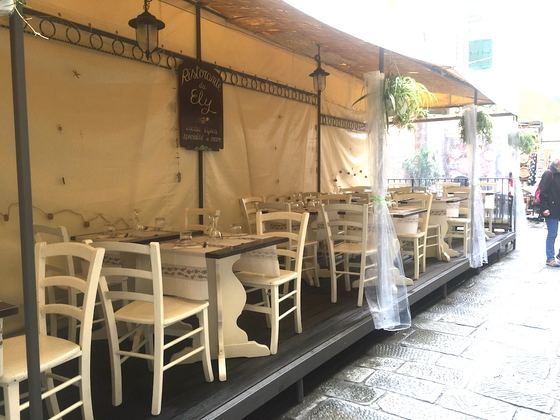
Ristorante Pizzeria Da Ely
Monterosso Al Mare (SP) · 8.6 km
LA PALMA D'ORO RISTORANTE PINSERIA Giovanni e Eleonora
Piano di Follo (SP) · 12.1 km
