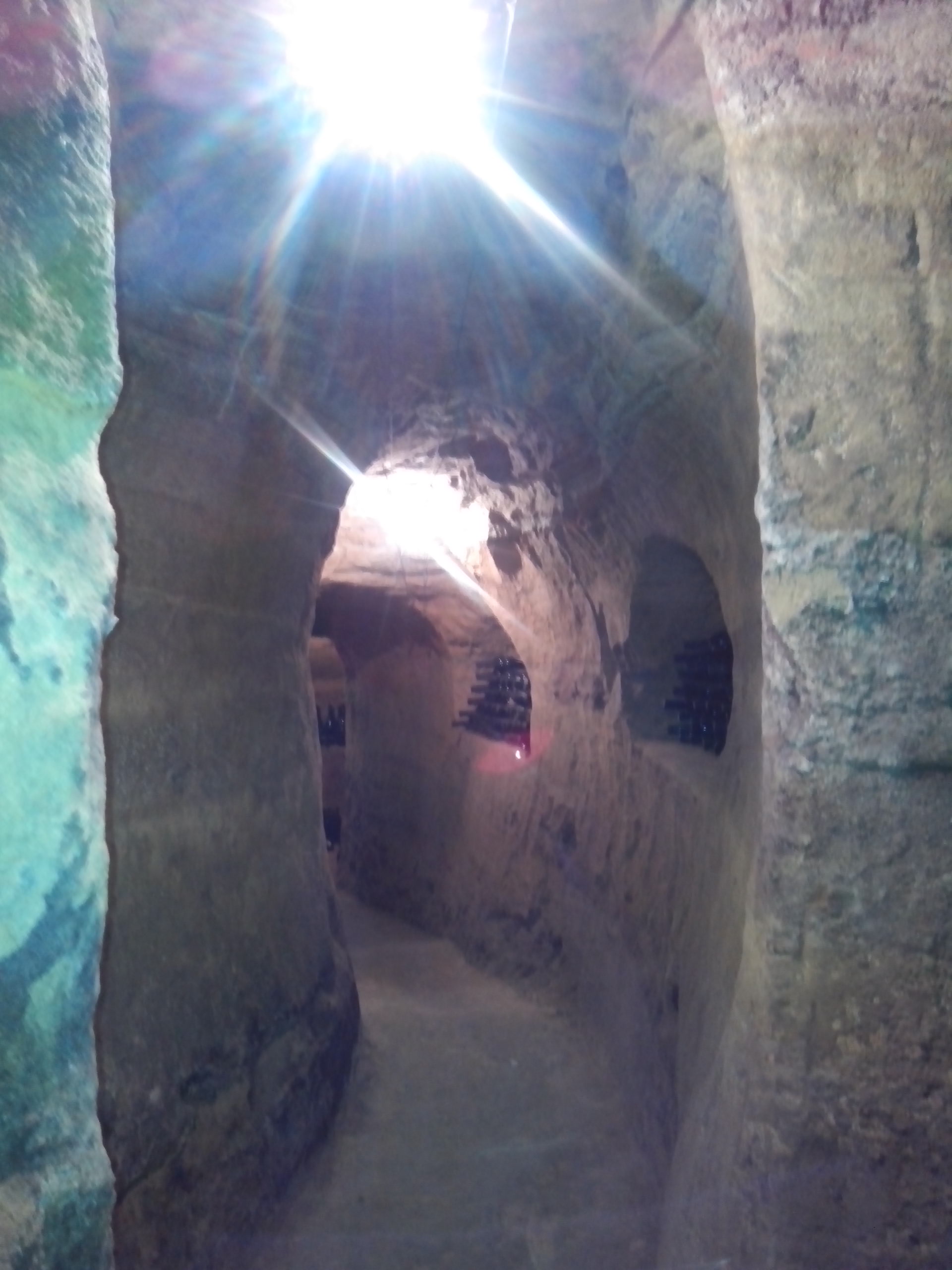
Small chambers carved into the sandstone beneath houses in Monferrato, traditionally used to store wine bottles under constant conditions of temperature and humidity. A UNESCO World Heritage site since 2014 together with the vineyard landscapes of Piedmont, they are a unique architectural and cultural expression tied to the local wine culture.
Beneath the hills of the Basso Monferrato casalese, just a few metres below the courtyards and kitchens of rural houses, lies a world that knows no seasons. Infernot are cavities hollowed out by hand in pietra da cantoni — the local sandy tufa stone, quarried from the geological beds that make up the subsoil of this part of Piedmont — and they represent one of the most singular architectural solutions that Italian peasant culture ever devised around wine. They are not cellars in the ordinary sense: they are windowless rooms, without artificial ventilation, without any active climate control system. And yet they hold an almost constant temperature all year round, oscillating between ten and fourteen degrees Celsius, with a humidity level that preserves corks and slows oxidation. The physics of the subsoil does the work that elsewhere would require technology.
The name, in its harshness, says something precise: it recalls the infernal heat felt in summer when descending from the full light of the vineyards into the damp darkness of these chambers, where the temperature difference with the outside can exceed twenty degrees. Infernot are found mainly in the towns of the Monferrato casalese, in the province of Alessandria, with a notable concentration in villages such as Rosignano Monferrato, Vignale Monferrato and Ottiglio. They are carved directly into the pietra da cantoni beneath houses or existing cellars, often reached through a hidden entrance, a trapdoor, a narrow stair descending into darkness. The walls, ceilings and floors are entirely of worked stone, at times with a formal care that goes beyond pure function: round arches, niches shaped to hold bottles, decorations carved by hand by the owners themselves.
This practice is rooted in a domestic economy in which wine was a primary asset and its proper conservation a matter of economic survival as much as family pride. Every infernot was — and in many cases still is — strictly personal: built by the head of the household or by his forebears, expanded over time, kept with a certain discretion. There was no standardised type, nor any codified trade of stone-digger: one learned by watching, working with picks and chisels, letting the stone yield according to its own nature. The result is a remarkable morphological variety, in which each chamber bears the mark of whoever made it.
In 2014, the infernot were included in the UNESCO serial site named "The Vineyard Landscape of Piedmont: Langhe-Roero and Monferrato", recognised as a World Heritage Site. The recognition concerns not a single monument but a system of relationships between landscape, rural architecture and cultural practices tied to viticulture. The infernot fall within it as a component of the Monferrato casalese, evidence of how the care of wine took shape in built forms that endure across centuries. Today some of them can be visited, including through the Ecomuseo della Pietra da Cantoni (Ecomuseum of the Cantoni Stone), which has made them an object of documentation and territorial promotion.
What strikes one, descending into one of these spaces, is the measure of the original gesture: no waste, no display, an exact answer to a precise problem. The pietra da cantoni, quarried and then reused as a protective shell, completes a double cycle — first a building material above ground, then a thermal shield below it. The wine that rests there is not necessarily a great collector's cru: historically these held bottles of family production, Barbera, Grignolino, Freisa, the everyday wines of Monferrato. The infernot is not a place of display but of silent care, and this discretion is perhaps its quality hardest to put into words.
Frukko · CC BY-SA 3.0 — Wikimedia Commons
Certified Made in Italy businesses close to this place.
Onoranze Funebri Palma Srl - Di Palma Roberto Dal 1991
Rocchetta Tanaro (AT) · 9.2 km
Azienda Agricola Gatti Piero
Santo Stefano Belbo (CN) · 12.4 km
Pizzeria La Dolce Vita
Acqui Terme (AL) · 13.8 km
Canepa Serramenti
Acqui Terme (AL) · 14.1 km
BAR TAVOLA CALDA ''IL GHIOTTO''
Acqui Terme (AL) · 14.3 km
RISTORANTE - DA NONNA GINA
Acqui Terme (AL) · 14.3 km
