A circular itinerary of nearly 350 km crossing the heart of Valle d'Aosta, walkable in either direction. It links villages, castles and alpine landscapes in a slow route designed for those who want to immerse themselves in the region.
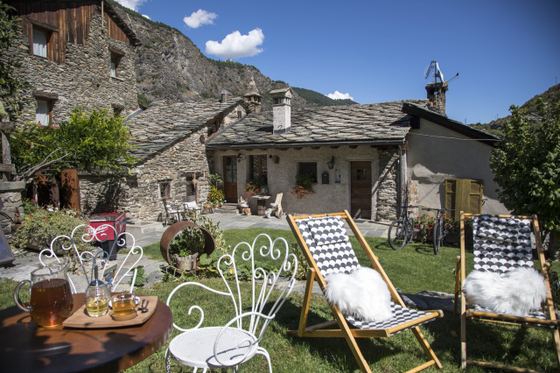
The Dora Baltea gave its name to everything: to the river that runs through Valle d'Aosta from east to west, and to the path that follows its logic without ever quite coinciding with it. The Cammino Balteo is a circular itinerary of nearly 350 kilometres that embraces the entire region at medium and low altitude, touching more than forty municipalities and crossing a landscape that shifts register continuously — chestnut woods, open pastures, terraced vineyards, grey stone villages huddled around their churches.
The route unfolds across twenty-three stages, walkable in either direction and tackled either in full or in segments. The signage is uniform: yellow trail markers with the number 3 set inside an inverted triangle. This formal consistency reflects a deliberate choice — to build a path legible even to those unfamiliar with the territory, without simplifying it in the process. The stages lead through minor villages that rarely appear in conventional itineraries, alongside medieval castles and archaeological sites that Valle d'Aosta preserves in unusual numbers for a region of this size.
What sets the Balteo apart from a simple hiking trail is its elevation. Staying at mid-slope or in the valley floor, the path keeps a pace that is accessible and that favours attention to detail: the rural architecture of the villages, traditional building techniques, the marks of agricultural work on the landscape. The name itself — echoing Balteus, the Latin name for the Dora Baltea — places the route within a historical continuity reaching back to Roman times, when the valley was a strategic corridor toward the Alps and the passes of Gran San Bernardo and Piccolo San Bernardo.
The path lends itself to distinct seasonal readings. In spring and autumn, the agrarian landscape is at its most legible, with vineyards marking the slopes and orchards in bloom or in harvest. Summer brings the high-altitude pastures into view, even though the route does not reach them directly. Winter is walkable in stretches, with a low, raking light that alters the perception of the buildings and the terrain. This variability is not incidental: it is part of the path's structure, which changes appearance depending on when it is walked.
For those seeking in walking a form of conscious deceleration, the Balteo offers something precise: not the spectacle of peaks, but the layered complexity of a territory inhabited for millennia. Each stage carries with it a measure of history — Roman, medieval, rural — that is not presented as scenery but is encountered along the way, in the dry-stone walls, the bridges, the votive chapels at the edges of the trails. It is a territory that reveals itself slowly, at a walking pace, in the only way certain things become visible.
Lidernen · CC BY-SA 4.0 — Wikimedia Commons
Certified Made in Italy businesses close to this place.