A small Alpine borgo in the Gran San Bernardo, known for its flower-adorned stone houses and an atmosphere from another era that has earned it a place among Italy's most beautiful villages.
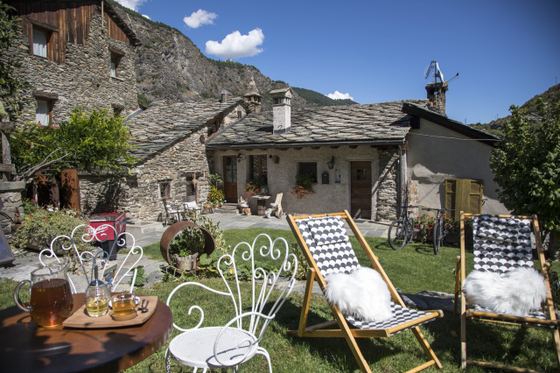
Etroubles stands at 1,270 metres above sea level in the Gran San Bernardo valley, along the route of the via Francigena, the ancient artery that for centuries connected the British Isles to Rome across the Alpine arc. This is no accidental location: this stretch of valley was one of the mandatory passages for pilgrims, merchants and armies, and the borgo still carries in its cobbled lanes and local stone façades the layered memory of that continuous transit. Its recognition as a Bandiera Arancione (Orange Flag) municipality from the Touring Club Italiano, and its inclusion on the list of Italy's most beautiful villages (Borghi più belli d'Italia), attest to a quality of the whole that goes beyond the formal preservation of buildings.
The medieval core is arranged around fountains and dwellings built with the grey stone of the mountain, packed into lanes that follow the shape of the land rather than any imposed geometry. The parish church, rebuilt in 1815, retains a fifteenth-century pointed bell tower that remains the visual landmark of the village skyline. Within the village, two small museums document aspects of local material life: the Museo della Latteria (Dairy Museum) illustrates the stages of milk processing with nineteenth-century tools, including the making of fontina; the Centrale Bertin gathers machinery and documents relating to hydroelectric power generation in the area from the early twentieth century onward. These are tangible archives of a community that has learned to adapt to the resources of its own environment without erasing them.
The calendar of traditions marks the borgo with two distinct moments. The Carnevale di Etroubles is recognisable for the costumes of its masked figures: garments embroidered with sequins, rosettes and small mirrors, still made today within the Comune, whose shapes recall the passage of Napoleonic troops through the pass. In August, the event known as Veillà brings the historic centre to life with forms of Alpine folklore tied to the valley's oral and communal culture. Neither occasion is a reconstruction staged for outsiders; both are practices the local community keeps alive with continuity.
Over these historical layers, a contemporary artistic intervention has been added with discretion: sculptures and frescoes by Italian and foreign artists have been installed in the public spaces of the borgo, forming a permanent open-air museum known by the title *Étroubles, avant toi sont passés*. The choice to entrust the surfaces and margins of the village to site-specific works of art does not alter the reading of the historic fabric, but adds a further layer that engages in dialogue with the sedimentation of previous centuries. The project's very name — which in French means «before you, others have passed» — explicitly recalls the vocation for transit that has defined this place since its origins.
CaterinaFis · CC0 — Wikimedia Commons
Certified Made in Italy businesses close to this place.