Florence and its hinterland are the Italian heart of artisanal leatherworking, with a concentration of small workshops that still practise hand stitching according to historic techniques.
In Florence, leatherworking is not a heritage confined to museums. It is a craft that continues to be practised in the workshops of the historic centre and in the city's hinterland, handed down through precise gestures and manual tools that no machine has yet matched. The first documented traces date back to the late thirteenth century, when the Arte dei Galigai (Guild of Tanners) brought together under a single corporation the various figures of the trade: the Pelacani, who tanned raw hides; the Pezzai, who sold leather; the Orpellai, who specialised in gilding. The guild's patron was Saint Augustine, and every 28 August it paid homage to him in the church of Orsanmichele. Along the Ponte Vecchio operated the Arte dei Beccai (Guild of Butchers), which supplied the raw material, while the tanneries were distributed upstream and downstream of the Arno: water was the indispensable resource for treating slaughtered hides, and the city's street names still preserve, on marble plaques, the memory of that presence.
The very word conceria (tannery) descends from the Latin *coriarius, pellium concinnator* — tanner of hides — and the word Galigai points to a root meaning one who works raw leather. This layering of language is a trace of a production system that, in the Middle Ages, was already articulated and specialised, with distinct roles and an internal hierarchy recognised by the Florentine Republic. Over the centuries, production has moved away from the riverbanks, but the geographic concentration has not dissolved: the Florentine area remains today one of Europe's densest hubs for artisanal leatherworking, with a network of small and medium-sized businesses that often operate as family-run workshops or with small teams.
What sets this tradition apart from industrial production is the centrality of the manual gesture. The Florentine leather craftsman works with awls, curved needles, waxed linen thread and wooden forms, selecting materials upstream and overseeing every stage of the process. Hand stitching — saddle stitch, double-needle stitching — guarantees a strength and evenness that industrial sewing machines cannot replicate with the same consistency on full-grain leather. This skill is still passed on through direct mentorship inside the workshops, rather than through formal training paths, which means its continuity depends on the physical presence of masters willing to teach and apprentices willing to learn slowly.
The territorial context in which this craft survives is neither that of the great maisons nor that of mass distribution. It is a discreet geography, made up of addresses in the Quartiere di Santa Croce (Santa Croce district) — historically the tanning heart of the city — and artisanal workshops in the peri-urban belt. The Florentine leather goods supply chain still involves figures specialised in different stages: those who prepare the patterns, those who cut, those who assemble, those who finish the edges by hand-dyeing. Each step requires specific knowledge, and the quality of the finished product is the result of this sequence of distinct skills meeting along the chain.
Certified Made in Italy businesses close to this place.
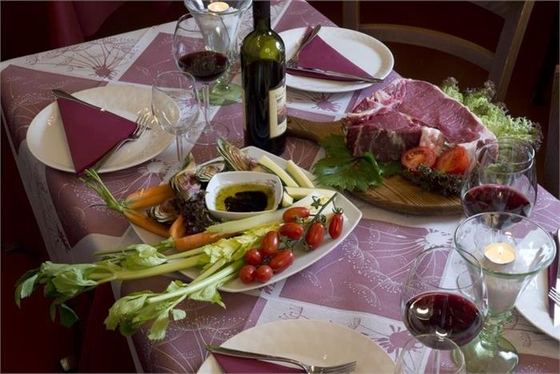
Il Barroccio Antica Osteria Firenze
Firenze (FI) · 0.2 km
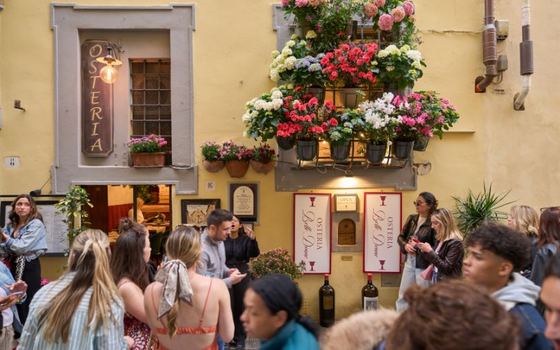
Osteria Belle Donne
Firenze (FI) · 0.5 km
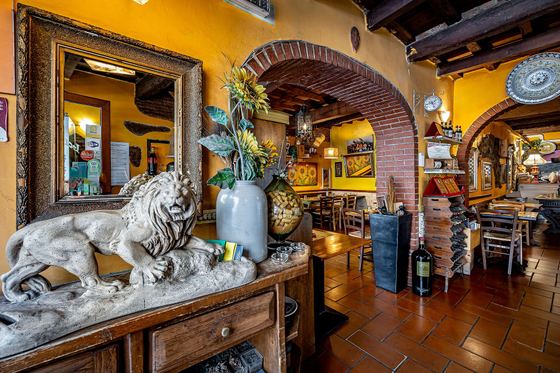
La Grotta Di Leo
Firenze (FI) · 0.9 km

OSTERIA CAORLOTTA - Firenze - RISTORANTE DI PESCE
Firenze (FI) · 1.1 km
Alvise Giustinian Murano Glass Florence
Firenze (FI) · 1.4 km
OSTI srl PAVIMENTI E RIVESTIMENTI
Novoli (FI) · 1.4 km
