Before you go on
This site uses only what it needs to work: the language you choose, access to the members' area, and anonymous counts that tell us whether the search is answering well. For advertising campaigns we ask your permission, and without a yes nothing starts. See the full list.

Housed in the town of Montesarchio, it holds artefacts from the Samnite era including the celebrated krater by Assteas, one of the most significant works from Magna Graecia. It offers a gateway to the pre-Roman history of the Valle Caudina, a territory also rich in food and wine traditions linked to the Taburno.
Montesarchio occupies a precise geographical position: the Valle Caudina, that natural corridor between the Taburno massif to the north and the Partenio to the south which for centuries served as one of the obligatory passages between Tyrrhenian Campania and inland Sannio. The town is recognisable from afar by the Lombard tower rising on the hill, the remnant of a defensive system layered over time. It is in this context — a territory crossed by armies, merchants and cultures well before Rome redrew its borders — that the Museo Archeologico Nazionale del Sannio Caudino is set.
The museum gathers material evidence of the Samnite peoples who settled permanently in this part of inland Campania in the centuries before Romanisation. The collection documents funerary practices, craft production and trade exchanges of a civilisation that historiography has long read almost exclusively through the filter of Roman sources. The objects on display offer instead a direct perspective: ceramics, weaponry, personal ornaments that speak of an articulated society, in contact with the routes of Magna Graecia and with the centres of the Campanian coast.
The piece that has given the museum a resonance reaching beyond the regional sphere is the krater attributed to Assteas, a ceramic painter of Paestan origin active in the 4th century BC. The vase, found in Caudine territory, belongs to the tradition of Italiote red-figure pottery and stands as one of the most significant examples of this production in the panorama of ancient southern Italy. Assteas is known to scholars for a recognisable narrative style, capable of translating mythological scenes into images with a compositional vivacity that distinguishes his hand from that of his contemporaries. The presence of his work in Montesarchio testifies to the permeability of these territories to influences from the coast, and to the capacity of the Caudine Samnites to integrate prestigious objects into their ritual and funerary practices.
The museum sits within a territory that preserves traces spanning a long duration: from prehistory to the Roman presence, through to the Lombard and Norman Middle Ages still legible in the castle's architecture. The Valle Caudina is also the landscape of Taburno-Camposauro, a protected area that includes the vineyards from which Aglianico del Taburno comes, a denomination of controlled origin. This interweaving of historical stratification and quality agricultural production defines a coherent territorial profile, in which the museum is not an isolated episode but a point of entry into a broader context.
Dirac4 · CC BY-SA 3.0 — Wikimedia Commons
Certified Made in Italy businesses close to this place.

A M SYSTEM Srl
Avella (AV) · 13.4 km
RISTORANTE PIZZERIA SERPINO
Durazzano (BN) · 15.8 km
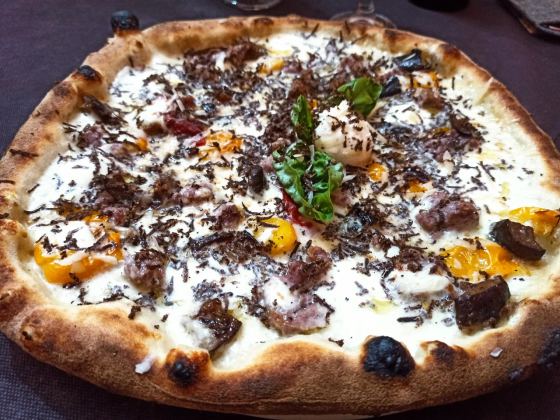
Bella ‘Mbriana
Sant'Agata de' Goti (BN) · 16 km
RISTORANTE I SAPORI DEL BORGO
Ospedaletto d'Alpinolo (AV) · 16.3 km
Chalet Caffe' del Professore dei F.lli De Lucia
Nola (NA) · 17.9 km

FIOCCHI DI NEVE GELATERIA ARTIGIANALE DAL 1989
San Giorgio del Sannio (BN) · 17.9 km