
In these two villages of the Ascoli hinterland survives a centuries-old tradition of copper working, carried on by coppersmiths who continue techniques learned over the centuries. One of the most deeply rooted expressions of metal and ironwork craftsmanship in the southern Marche.
In the hinterland of the province of Ascoli Piceno, tucked into the folds of the Marche Apennines, Force and Comunanza preserve one of central Italy's most enduring craft traditions: copper working. This is not a heritage confined to museums, nor a piece of folkloric re-enactment, but a practice that has crossed the centuries while maintaining a continuity of gestures, tools and knowledge passed down from generation to generation. For centuries the coppersmiths of these villages have forged everyday objects — pots, jugs, work containers — and in doing so have built a territorial identity that can still be recognised today in the sonic and material landscape of these places.
The origin of copper working in Force is wrapped in a narrative that blends history and legend. One of the most deeply rooted versions attributes the introduction of the craft to the monks of Farfa, who are said to have brought metallurgical techniques and knowledge with them. Another oral tradition tells of a gypsy named Boro, a skilled coppersmith, who, having lost his voice to a curse, began teaching the trade to the young through sounds and unintelligible utterances. From that fragmented, coded communication is said to have arisen the so-called "baccajamento", a peculiar dialect historically identified as the language of the Force coppersmiths — an internal code of the guild, at once a tool of recognition and of exclusion.
As a testament to this tradition, Force is home to the Museo Ramai (Coppersmiths' Museum), housed within Palazzo Canestrari and the former church of San Biagio, in the historic centre of the village. The museum, opened in 2005, gathers along its walls the tools and artefacts most representative of local production, and offers workshops in which copper working can be observed and practised firsthand. The institution does not limit itself to preserving objects: it seeks to keep alive the relationship between the artefact and the gesture that produces it, between the material and those who know it.
Comunanza, not far away, shares this artisanal backdrop with Force within a territory — that of the southern Marche — where metalworking, and wrought iron in particular, has historically found favourable conditions both in natural resources and in the social fabric of the villages. The tradition of wrought iron is widespread throughout the Marche region, but it is in the Ascoli area that it has developed some of its most recognisable forms, with workshops that have managed to withstand the industrial transformations of the twentieth century without dissolving entirely into the market for mass production.
What sets this tradition apart from many others that survive only in residual form is the persistence of a direct transmission of knowledge. Copper is still worked by hand, with hammers and anvils, following rhythms and techniques that resist acceleration. Every object bears the marks of this slowness — the irregularities of the surface, the variations in thickness, the patina the metal takes on over time. These are traces of a labour that has not sought to hide behind industrial perfection, and it is precisely in this visibility of process that it finds its coherence.
Peter Forster · CC BY-SA 2.0 — Wikimedia Commons
Certified Made in Italy businesses close to this place.
Apicoltura Apegaia
Amandola (FM) · 12 km

Il Parco Di Snoopy Amici Per Sempre
Amandola (FM) · 12.3 km
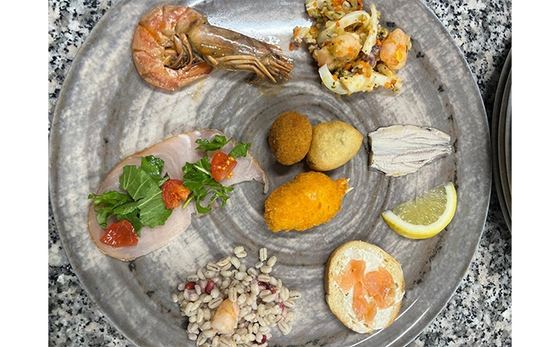
ZIO PIETRO - RISTORANTE PIZZERIA BAR
Ascoli Piceno Poggio di Bretta (AP) · 16.5 km
Palazzo Riccucci Resort
Montappone (FM) · 20.1 km
Bar Centrale Gelateria Incicco
San Ginesio (MC) · 21.7 km
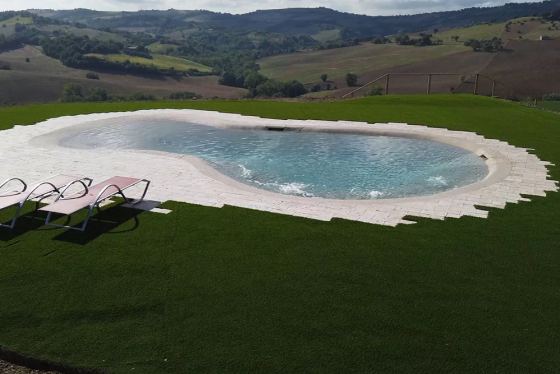
Villa Angela Country House
Fermo (FM) · 23.7 km
