
Salento's pizzica has its roots in ancient healing rites tied to the taranta's bite, surviving as a collective musical and dance practice across Salento. It is not simply a dance, but an internationally recognised ethnomusicological heritage.
In the heart of Salento, in Galatina — a town in the province of Lecce, at the far southern tip of the Italian peninsula — lies the memory of one of the most studied and most difficult to classify ritual phenomena in European ethnography. Tarantism was not a marginal superstition nor an isolated folkloric episode: it was a system of collective response to affliction, documented since at least the Middle Ages and observed continuously until the late 1950s, when the last tarantate (women believed to be afflicted by the taranta's bite) still made their summer pilgrimage to the chapel of San Paolo.
The logic of the rite turned on a single premise: the bite of the taranta — a spider identified with the Lycosa tarantula, common in the countryside of Salento — provoked in its victim a crisis that contemporaries described as hysterical-convulsive, marked by prostration, agitation, and an inability to work. The tarantate were almost always women, almost always peasants, and almost never from Galatina itself: they came from neighbouring towns — Nardò, Aradeo, Cutrofiano — from the farmland where the "bite" occurred during the wheat harvest, in the hottest months. The crisis tended to recur every summer, with a regularity that the medicine of the time could not explain, and which twentieth-century scholars — beginning with the foundational fieldwork of Ernesto de Martino in the 1950s — have reinterpreted as the symbolic expression of a social suffering that otherwise had no voice.
The therapy prescribed by tradition was music and prolonged dance. Players of tambourine, violin and organetto (a small diatonic accordion) accompanied the tarantata for hours, shifting rhythm and key until the body found the movement matching its own state. Each taranta was believed to have its own colour and melody: the dance was at once diagnosis and cure, and the tambourine — a struck-membrane instrument capable of frequencies that act physically on the nervous system — was its cornerstone. Full recovery, however, required one further, obligatory step: a pilgrimage to the chapel of San Paolo in Galatina, on the feast day of the saint, June 28th and 29th. Here tradition held that the women would drink water from the well in the adjoining courtyard, and bring it back up during the crisis, as an act of expelling the affliction. The bond with San Paolo stemmed from a local legend: the apostle, hosted by a man of Galatina during his travels, was said to have granted the town's inhabitants the power to heal from the venom of dangerous creatures.
What remains today is no inert relic. Pizzica — the musical and dance form that grew out of that rite, taking its origin and structure from it — is practised throughout Salento as a living expression of collective identity. The Notte della Taranta festival, held every summer in Melpignano, draws hundreds of thousands of people each year to listen and dance to music that still carries, in its rhythm, the trace of that ancient function. The chapel of San Paolo in Galatina, small and austere, stands in the heart of the historic centre, next to the Basilica of Santa Caterina d'Alessandria: two buildings that represent, side by side, the official sacred and the popular sacred, with no true separation ever having existed between the two.
Lupiae · CC BY-SA 3.0 — Wikimedia Commons
Certified Made in Italy businesses close to this place.
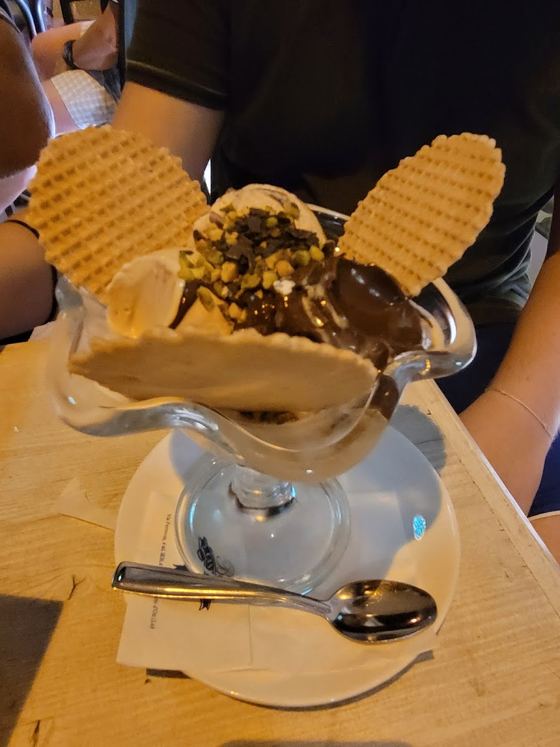
Bar Castello
Corigliano D'otranto (LE) · 7.8 km
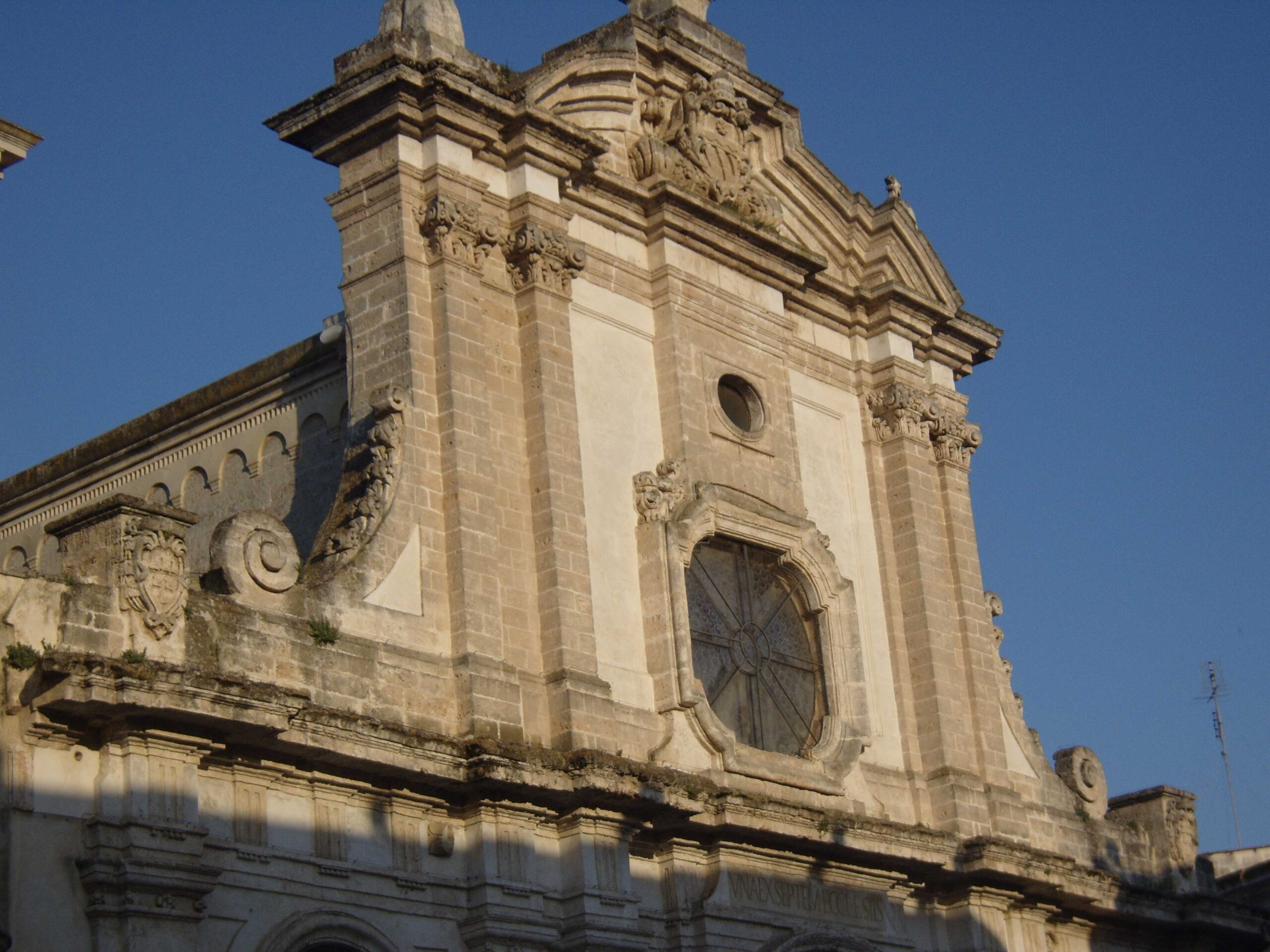
LA CATTEDRALE - Enoteca Osteria Gintoneria
Nardo (LE) · 11.7 km
Verde Giuranna
Parabita (LE) · 13.9 km
HOME RESTAURANT LA LOCANDA TA NONNA TUTA
Parabita (LE) · 14.5 km
PIZZERIA LA CUNGRECA
Supersano (LE) · 18.2 km
CELSIUS PIZZERIA
Lecce (LE) · 18.8 km
