
Volcanic hills a few kilometres from Padua, with trails through woods and vineyards and villages gathered on the slopes. A gentle, unusual landscape amid the Veneto plain.
Emerging from the Po Valley like a petrified archipelago, the Colli Euganei comprise eighty-one hills of volcanic origin that break the flat expanse of southern Veneto with a geological logic tens of millions of years old. This is not a volcano in the common sense of the word: the rocks that make up these hills — basalt, trachyte, tuff — are the result of magmatic intrusions that occurred between the Eocene and Oligocene epochs, when masses of molten material rose through marine sediments without ever reaching the surface. Uplift and subsequent erosion shaped an irregular morphology over time, in which each hill has its own form and elevation, and Monte Venda, at 601 metres, is the highest point of the entire system.
The Colli Euganei Regional Park, established in 1989, protects an area of roughly 18,694 hectares that brings together environments strikingly different in character. On the sunnier, drier slopes, a sub-Mediterranean vegetation survives — downy oak, manna ash, smoke tree — evoking landscapes far to the south. Higher up, chestnut woods cover the slopes in a quiet, unbroken cover, while the vegri, dry meadows on calcareous substrate, host botanical species rare in the wider Po Valley context. Among the hills, vineyards produce wines with a protected designation of origin, and small lakes fill hollows in the terrain with a stillness that contrasts with the density of settlement in the surrounding plain.
At the eastern foot of the hills, Este preserves traces of human presence dating back to the Bronze and Iron Ages: the Paleo-Venetic civilisation, which had one of its main centres here, left behind artefacts now gathered in the Museo Nazionale Atestino (National Atestine Museum), housed in the Carrarese castle. The very name of the town — Ateste in Latin — points to this deep stratification. Further north, Arquà Petrarca holds the house where Francesco Petrarca spent his final years, until his death in 1374. The village, with its narrow streets and stone façades, retains a scale that has not substantially changed since the poet knew it.
The thermal waters that emerge at the foot of the hills, particularly around Abano Terme and Montegrotto Terme, belong to the same hydrogeological system as the surrounding hill country. Rainfall that falls on the Venetian Prealps seeps into the subsoil and travels an underground course of tens of kilometres before rising back to the surface, warmed by geothermal heat, reaching temperatures that can exceed eighty degrees Celsius at the source. This connection between the elevation of the hills, the plain, and the deep waters is one of the traits that make the Colli Euganei a coherent territorial system, rather than a mere anomaly in the landscape.
Walking the park's trails means moving through layers of superimposed time: volcanic rock underfoot, rows of vines planted by hands passed down through generations, the bell towers of villages visible from above against the plain stretching to the horizon. On clear days, from the summit of Monte Venda or Monte Cero, the view reaches the Prealps to the north and, under the most favourable conditions, the Venice lagoon to the east. It is a perspective that reverses the usual relationship between plain and hill: from up here, the plain is not a backdrop but the main subject, and the hills become the fixed point from which to take its measure.
Threecharlie · CC BY-SA 4.0 — Wikimedia Commons
Certified Made in Italy businesses close to this place.

S.I.B. SNC DI MURARO E & C
Este (PD) · 1.5 km
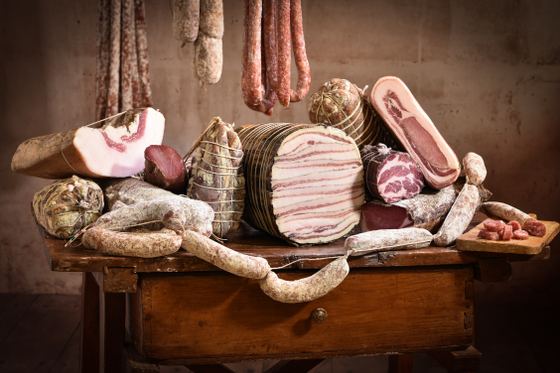
Bertelli Salumi Srl
Montagnana (PD) · 13.3 km
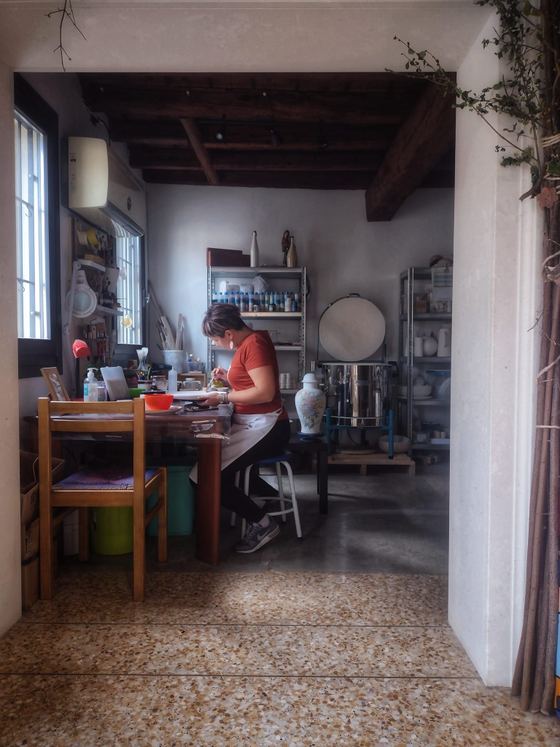
Idee Concrete di Marzia Gaglian
Montagnana (PD) · 15.1 km
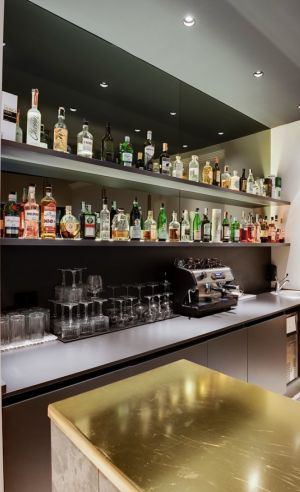
RISTORANTE POESIA
Abano Terme (PD) · 17.9 km

De Mori Specialità Porchetta
Albignasego (PD) · 22.5 km
Tipografia e Studio Grafico Colore&Stampa Arti Grafiche
Pressana (VR) · 25.6 km
