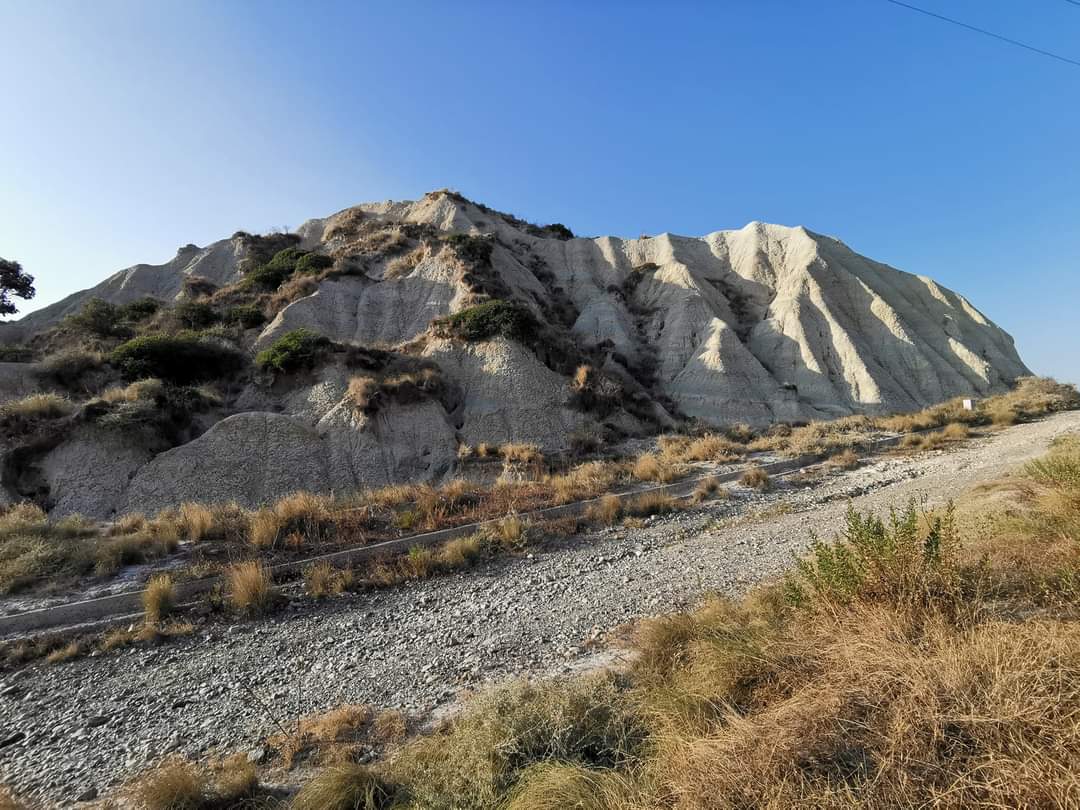
White clay formations shaped by water into a lunar landscape at the heart of the Aspromonte, little known to the wider public. A walk through these badlands offers views of rare natural beauty.
On the southern slope of the Aspromonte, among the hills that descend toward the Ionian Sea in the province of Reggio Calabria, the territory of Palizzi holds one of Calabria's most unusual landforms. The Calanchi Bianchi (White Badlands) are the result of a slow, continuous erosive process: over the centuries, rainwater has cut into the scaly clays of the geological substrate, sculpting a system of spires, sharp ridges and deep furrows that cover the landscape in a whitish tone, almost devoid of vegetation. The phenomenon belongs to the family of badlands found in various areas of the Italian Apennines, but here it takes on a character of its own, shaped by the local mineral composition and by exposure to the Mediterranean sun and wind.
The geomorphology of the site is typical of impermeable clays subjected to differential erosion: as rain runs across the surface without soaking into the ground, it carries away thin layers of material and carves ever-deeper channels, gradually generating the pinnacle-like forms that define the landscape. The result is a relief in constant transformation, where every rainy season slightly redraws the profiles. The low afternoon light raking across the white ridges sharpens the contrast between shadowed and sunlit surfaces, making the terrain particularly easy to read.
The town of Palizzi lies within the Greek-speaking area of the Locride, a territory that still bears traces of the medieval Greek-Byzantine presence, visible in the Norman castle overlooking the upper village. The proximity between this historical stratification and the geomorphological landscape of the badlands gives the area a double nature: on one hand, the living, ever-changing matter of the earth; on the other, stone worked by human hands in remote eras. The paths crossing the clay formations can be walked with a local guide, since the terrain—crumbly and unstable in places—requires care and a sense of orientation.
The site's limited fame beyond regional hiking circuits has, until now, kept visitor numbers low, leaving the place's sense of isolation intact. In a territory like the Aspromonte, where the complexity of the terrain has historically limited settlement and slowed the development of infrastructure, the Calanchi Bianchi di Palizzi remain a privileged vantage point onto natural processes that elsewhere are often concealed by urbanization or dense vegetation. Here, instead, the earth reveals its own structure without mediation.
Marcuscalabresus · CC BY-SA 4.0 — Wikimedia Commons
Certified Made in Italy businesses close to this place.