
An early medieval monastic foundation in the Val Trebbia, at the heart of the spread of Irish culture across continental Europe through the monk Columbanus. The village that grew up around it preserves a historic fabric of rare coherence.
In 614 AD an Irish monk named Columbanus chose a spot in the Val Trebbia (Trebbia Valley), in what is now the province of Piacenza, to found what would become one of the most influential monastic centres of early medieval Europe. Columbanus was already known for having crossed the continent bearing with him the ascetic and intellectual tradition of Irish Celtic monasticism, founding communities at Luxeuil, in Burgundy, and at Bregenz, on Lake Constance. Bobbio was his final stage, and the one destined to endure longest in the history of European culture.
The abbey that took his name became, over the following centuries, one of the most active scriptoria in the Latin world. The monks of Bobbio copied, preserved and transmitted texts by classical authors and Church fathers that would otherwise have been lost. The abbey library reached an extraordinary size: hundreds of codices, many of which are today held at the Biblioteca Apostolica Vaticana, the Biblioteca Ambrosiana in Milan and the Biblioteca Nazionale in Turin, where they arrived following the dispersals that came after the Napoleonic suppression of the monastery. Among the Bobbio manuscripts are palimpsests of exceptional rarity, parchments on which Christian texts were written over older writings, in some cases recoverable through modern analytical techniques.
The architectural complex visited today is the result of layers built up over more than a thousand years. The basilica preserves the crypt housing the relics of Columbanus, a site of continuous devotion since the early Middle Ages. The cloister, with its colonnade, and the adjoining monastic buildings document the transformations the monastery underwent between the Romanesque period and later Renaissance and Baroque reworkings. The village of Bobbio grew up around this nucleus, retaining an urban coherence that still makes legible the relationship between the monastery and the civic community that depended on it for centuries.
The Ponte Gobbo (Hunchback Bridge), which crosses the Trebbia with its eleven irregularly spaced arches, is the other visible sign of that medieval vitality. Popular tradition attributes it to the work of the devil, following a recurring motif in European folklore applied to constructions difficult to explain technically. The reality is that it is a medieval structure adapted over time to changes in the riverbed, which accounts for the unevenness of the arches. From the bridge, the view over the abbey and the outline of the village clearly conveys the geography of monastic power: the monastery in a dominant position, the river as a route of communication, the village as a dependent organism.
The Val Trebbia has remained outside the mass tourism routes that cross Emilia-Romagna along the Via Emilia or toward the Adriatic coast. This has spared Bobbio from the transformations that elsewhere have blurred the legibility of historic centres. The hilly landscape surrounding the village, with its wooded slopes running down to the river, is the same one Columbanus saw in 614 when he chose this place as the permanent seat of his work.
Davide Papalini · CC BY-SA 3.0 — Wikimedia Commons
Certified Made in Italy businesses close to this place.

Il Duomo Cafè
Bobbio (PC) · 2.5 km
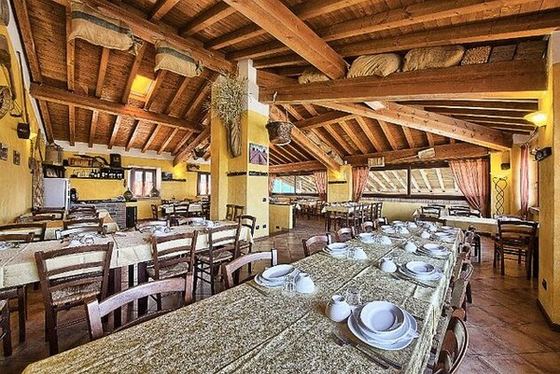
Agriturismo La Cantinetta
Rivergaro (PC) · 21.2 km
Alluminio Sistemi Srl
Niviano di Rivergaro (PC) · 24.1 km
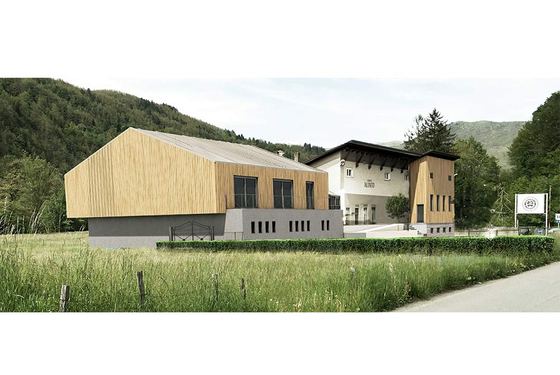
Caseificio Val D'Aveto
Rezzoaglio (GE) · 26.8 km
Riverfrut Società Agricola
Rivergaro (PC) · 27.9 km
Azienda Agrituristica - '' La Merenderia''
Bedonia (PR) · 29.8 km
