
Montagnana preserves one of Italy's best-preserved medieval city walls, with towers and gates that tell centuries of Veneto history. The walled town offers an authentic historic centre, far less crowded than other Veneto destinations.
In the Bassa Padovana, where the plain stretches flat toward the border with the Veronese, Montagnana appears as a closed perimeter of red brick emerging from the landscape without warning. The city walls, built between the 13th and 14th centuries under the lordship of the Carraresi, extend for roughly two kilometres in a form that survives almost intact, punctuated by twenty-four towers and marked by two monumental gates: Porta Padova to the east and Porta Vicenza to the west. Few medieval defensive structures in northern Italy have crossed the centuries with this degree of material continuity.
The origins of the fortifications are older than the form seen today. The earliest defences date back to Late Antiquity, when the site was protected by earthworks, ditches and palisades. After the 10th century, written sources document a sustained commitment on the part of the inhabitants to maintaining the castrum, with hoardings, drawbridges and masonry walls gradually replacing the earthen structures. It was, however, the Carrarese period that gave the walls their definitive form: the Carraresi, lords of Padua, turned Montagnana into a defensive stronghold of the first order along the western border of their domain, investing in the construction of two castle complexes — the Rocca degli Alberi and the Castello di San Zeno — which guard the two main gates and integrate the walls into an articulated system of control.
Within the walls, the urban fabric has remained largely consistent with its historical layering. Renaissance palazzi and churches face onto a centre that has not undergone the building transformations that altered many other Veneto towns over the course of the twentieth century. The cathedral of Santa Maria Assunta, its façade blending Gothic and Renaissance elements, stands on the northern side of the main square and holds works by Andrea Mantegna and Paolo Veronese. The relationship between the interior space and the surrounding walls is still legible in its original logic: the streets follow lines that respond to the geometry of the walls, and the ramparts walkway remains passable along much of its length.
Montagnana belongs to the association I Borghi più belli d'Italia (The Most Beautiful Villages of Italy) and has been awarded the Bandiera Arancione (Orange Flag) by the Touring Club Italiano — recognitions that attest to the quality of its conservation without translating into the kind of footfall seen in the Veneto's more celebrated art cities. This condition — a place historically dense yet relatively little visited — still allows for a direct reading of the architecture, unmediated by mass tourism. The walls can be walked, touched, measured out step by step.
Syrio · CC BY-SA 4.0 — Wikimedia Commons
Certified Made in Italy businesses close to this place.
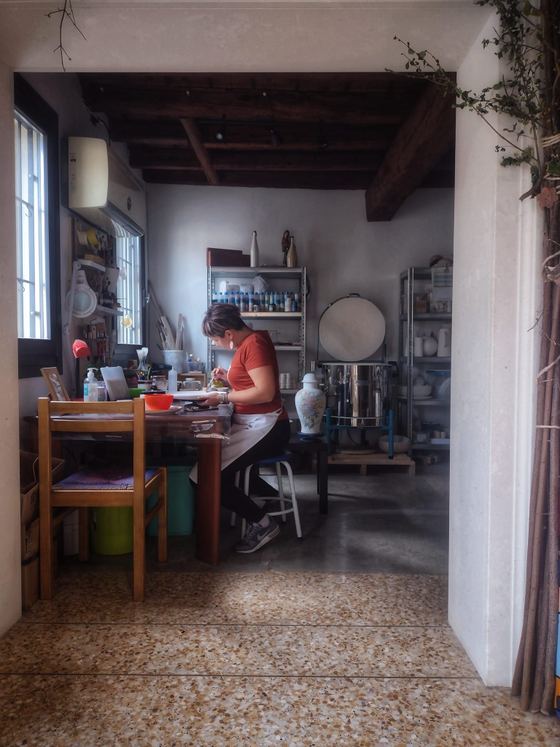
Idee Concrete di Marzia Gaglian
Montagnana (PD) · 1.1 km
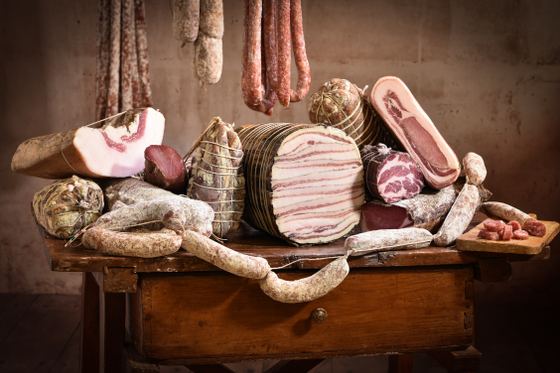
Bertelli Salumi Srl
Montagnana (PD) · 2.9 km
Tipografia e Studio Grafico Colore&Stampa Arti Grafiche
Pressana (VR) · 9.9 km

S.I.B. SNC DI MURARO E & C
Este (PD) · 17.6 km
INSTYLING Specialisti nell'Innovare il tuo look
Casaleone (VR) · 22 km
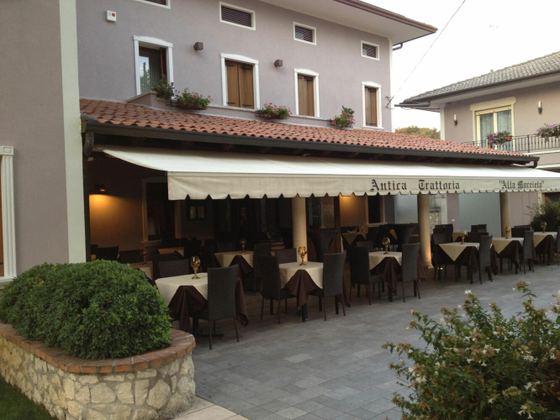
Antica Trattoria Moreieta
Arcugnano (VI) · 24.3 km
